Wednesday, January 9, 2008

Microsoft buys FAST Search & Transfer

Today's big news is that Microsoft is buying FAST for US$ 1.2 billion. FAST is a major player in the enterprise search market, and a merger opens interesting possibilities if and when Microsoft succeeds in integrating FAST's search technology with their own Sharepoint platform.


ABB currently has an enterprise agreement with Verity/Autonomy, which we use for all structured search on our web sites. In addition we're using Google's enterprise solution GSA to serve search results for unstructured content both on http://www.abb.com/ and on our intranet site inside.abb.com.


We have recently looked at FAST's search solution, and found it to be excellent. However, switching costs and uncertainty about the future development of FAST and their major competitors made us conclude that we should stick with Verity for the time being, and rather look at how we could fine tune the current solutions.


The different search platform evolve over time, and in addition our user needs are changing. When we scrapped using Verity for unstructured content and replaced it with Google's GSA some years ago, we were very happy with the resulting improvements. Now we see further improvement is needed, especially for the intranet.


Search on an intranet is inherently different from Internet search; While ranking of Internet search results to a great extent can rely on link popularity, intranet search must to a much greater extent depend on relevancy. Even if no search solution is either or, this calls for different weightings in the algorithms for the two vehicles.


With exponential growth in web content, both inside and outside the firewall, more focus on the issue of findability is called for. And search is an important element of this. Our plan is to look into possible short term improvements using the current solutions, while we start the process of assessing our long term options.

Thursday, January 3, 2008

Don't tamper with Wikipedia...

Over Christmas we've had a small edit war over the ABB article in Wikipedia. Someone, apparently associated with the company, tweaked the article in several places to paint a positive picture of the company and it's history. But Wikipedia is an encyclopedia and not a collection of marketing material, and sentences like "ABB is rated Number One in Power Technology in the World" has no place in an encyclopedia.

These edits were done on Dec 26, and probably thanks to Xmas it took several days before most of the changes were removed. But after that edits went back and forth several times in a small edit war. Hopefully it has calmed down by now, so the article will not be blocked from further changes in the future, waiting for tempers to calm...

The original changes are clearly not in compliance with Wikipedia's NPOV (Neutral point of view) policy., which is absolute and non-negotiable. There was no source quoted for this claim of supremacy. And while it may be correct that ABB on some occasions(s) have been "rated no 1 in power technology in the world" it is pretty obvious there is no institution entitled to bestow such an honour on an individual company. So it is pretty obvious that some of our competitors can claim the same.

As stated by Wikipedia, "The neutral point of view is a point of view that is neutral, that is neither sympathetic nor in opposition to its subject". This also mean that a careful selection of facts to support a specific view is a violation of the policy.

Be aware that also "anonymous" edits can be found out, by tracing the user's IP number using wikiscanner.

Writing a blogging policy is not as easy as you would think...

When we started out working out a blogging policy, it seemed fairly simple. There are private blogs and corporate blogs, and that is it.

But as we have been digging into the issue, what appears as distinct categories from the outset start blurring into each other. A corporate blog has to include some personal - and perhaps even slightly controversial - issues to attract and retain readers. Some personal blogs are more often than not about company related issues.

And is there really a difference between blogs and other types of web postings? Certainly not with regard to possible effects on the reputation of the company. So the policy needs to cover other forms of web postings that can be connected to ABB.

Also, the distinction between anonymous postings, personal postings and postings that can be connected to ABB starts blurring when you look close enough. No-one is truely anonymous on the web. If an ABB epmoyee should vandalize a Wikipedia entry about a competitor, he can be found out based on his IP address, even if he does so without identifying himself.

Here are some incidents in the past that I feel we need to address:

  • An employee posts slanderous information about the management of another company, stating his full name, title and name of ABB unit... I don't think anyone reading it would suspect ABB as such was behind it, but it is still unacceptable in my view.
  • An ABB employee has a blog that covers the use of ABB products. He feels a strong urge to tell George W. exactly what he means about the war in Iraq... He has every right to freedom of expression, but how should we handle this from the company's point of view?
  • An ABB employee anonymously stuffs articles on Wikipedia with ABB marketing material. He is outside ABB's corporate network so cannot be found out, but does that make it any more ethical? Anyone reading it would automatically suspect ABB is behind it...
  • We've also seen an much publisized incident on the web where a senior manager (not in ABB!) posted false rumours about the financial health of a competitor on news groups using a nickname.

Hopefully these issues are properly covered in the current version, but I am sure that we will need to go back and amend the guidelines as the web evolves.

ABB blogging and web posting policy

Here is the "final" version of our blogging policy that has been in the works for some time:

"In general, the company views employees' web involvement positively, and respects the right of employees to use the web as a medium of self-expression. However, if you choose to identify yourself as an ABB employee or to discuss matters related to our technology, business or activities, please bear in mind that, although you and we view your web postings as a personal project and a medium of personal expression, some readers may nonetheless view you as a de facto spokesperson for the company. In light of this possibility, we ask that you observe the following guidelines:


  1. The principles and guidelines that apply to ABB employees at work also apply to their on-line activities. Know and understand ABB's Code of Conduct and relevant Group directives and instructions. Please contact Group Function Legal and Compliance in case of doubts.
  2. ABB strives to compete fairly and thus the web should not be used for covert marketing or public relations. This is especially important if you post anonymously to third party web sites. Remember: No-one is truly anonymous on the web and your postings may be tracked back to you or the company and damage our reputation.
  3. Make it clear to your readers that the views you express are yours alone and that they do not necessarily reflect the views of ABB. If you have a blog or personal website, reduce the potential for confusion by putting the following notice – or something similar – in a reasonably prominent place: "The views expressed on this website/blog are mine alone and do not necessarily reflect the views of my employer."
  4. The best way to be interesting is to write about what you know. Try to add value by providing worthwhile information and perspective. If you have a deep understanding of something, talk about the challenges and issues around it. Respect your audience.
  5. Be careful to avoid disclosing any information that is confidential or proprietary to ABB or to any third party that has disclosed information to us. Do not publish specifics about ABB's relationship to customers or partners without their explicit consent. Be extra careful with information related to financial performance to make sure you are in compliance with financial disclosure regulations.
  6. Be as respectful to the company, our employees, our customers, our partners and affiliates, and others (including our competitors) as the company itself endeavors to be. Show proper consideration for others' privacy and avoid comments which may be derogatory in nature. This includes material that relates to aspects of gender, race, age, nationality, sexual orientation, politics, religion or physical ability.
  7. You may not attack personally fellow employees, customers, competitors, vendors, or shareholders. You may respectfully disagree with company actions, policies, or management.
  8. Remember that what you publish will remain public for a long time.
  9. Be the first to correct your own mistakes, and don't alter previous posts without indicating that you have done so.
  10. Respect the copyright of others.
  11. You may provide a link from your site to the corporate website. However you will require permission from Corporate Communications to use company trademarks or reproduce company material on your site.
  12. If a member of the media contacts you about an ABB-related blog posting or requests ABB information of any kind, contact Corporate Communications. Do not convey information to any outsiders that should not be made public.
  13. Ensure that your blogging activity does not interfere with your work commitments.
  14. Finally, please be aware that the company may request that you temporarily confine your website or weblog commentary to topics unrelated to the company if it believes this is necessary or advisable to ensure compliance with securities regulations or other laws. "

Wednesday, December 19, 2007

Weblogs are 10 years this week and I have a new look!

The word "weblog" celebrates the 10th anniversary of it being coined on 17 December 1997, according to BBC's web site.

The word was created by Jorn Barger to describe what he was doing with his pioneering Robot Wisdom web page. The word was an abbreviation for the "logging" of interesting "web" sites that he featured on his regularly updated journal. The abbreviation "blog" was only invented a couple of years later, and has come to signify raving 'n ranting in many users' mind. But I aim to stay (mainly) with Barger's concept...

Those of you who click through to my blog itself will notice it has now cast aside the standard blogspot template and aquired an ABB look in line with our other web sites.

Comments are welcome, and if you are planning an ABB blog get in touch with me to use the same template.

Jacob Nielsen: Web 2.0 can be dangerous...

Jacob Nielsen, the unchallenged web usability guru, has a strong word of warning in his Alertbox this week. Over-hyped Web 2.0 technology developments risk diverting resources from the high-ROI design issues that really matter to users.

Nielsen has previously aired his scepticism to excessive use of new technologies, but admits that Web 2.0 ideas are not inherently bad for users.

"They can be highly effective; we sometimes see examples of usability-enhancing Web 2.0 designs in our studies. But it's more common to find Web 2.0 ideas that either hurt users or simply don't matter to users' core needs. While the latter case might seem innocent, irrelevant website "enhancements" diminish profits because they indicate a failure to focus on those simpler design issues that actually increase sales and leads."


Nielsen notes that community features are particularly useful on intranets The reasons communities work better on intranets also explains why they're often less useful on the open Internet:

  • A company's employees are an actual community with a crucial shared interest: succeeding in business.
  • Employees are pre-vetted: they've been hired and thus presumably have a minimum quality level. In contrast, on the Web, most people are bozos and not worth listening to.
  • Although some intranet communities — such as those around internal classified ads — are aimed at lightening up the workplace, most intranet communities are tightly focused on company projects. Discussions stay on topic rather than wandering all over the map.
  • Intranet users are accountable for their postings and care about their reputation among colleagues and bosses. As a result, postings aim to be productive instead of destructive or flaming.
  • Small groups of people who know each other are less susceptible to social loafing, so more users contribute to intranet community features. In contrast, Internet communities suffer from participation inequality, where most users never contribute and the most active 1% of people dominate the discussions.

As an extremely rough guideline, here's Nielsen's advice as to what the percentage of Web 2.0 infusion that might benefit different types of user experience:

  • Informational/Marketing website (whether corporate, government, or non-profit): 10%
  • E-commerce site: 20%
  • Media site: 30%
  • Intranets: 40%
  • Applications: 50%

Applications score so high because users perform actions repeatedly and thus truly benefit from rich UI possibilities. In contrast, mainstream websites have very few repeated actions that justify the added complexity of a full GUI's shortcuts.
For website usability, the problem is not whether a specific operation takes 1 second or 10 seconds; people typically perform each operation only once or twice. The problem for websites is the 5-10 minutes users lose when they do something wrong because the site is too complicated. (After such an experience, they usually leave — and you lose the business.) Simplicity is more important than efficiency for done-once actions.

To read the full article, go here.

If you want to subscribe to his newsletter, go here.

Monday, December 17, 2007

Stop doing social because it's cool, do it because it's effective

I came across a useful article over at Forrester's Groundswell blog on introducing social web technologies - blogs or communities. No rocket science, just common sense, but perhaps useful none the less.

"What do most companies do wrong when they enter the social world? No, it's not that they're being fake, or don't "get it." It's that they don't really know their objectives."

"Is your company doing its social strategy backwards? If you started by saying "we should do a blog" or "we should create a page on a social network" or "we should create a community" the answer is probably yes."

"It's time to stop doing social because it's cool. It's time to start doing it because it's effective."

To help clients with this fundamental idea, they've come up with a little acronym called POST: People, Objectives, Strategy and Technology. Do it in this order, don't get it backwards!

Wednesday, December 12, 2007

Dopplr is opening up

Dopplr is a site that keeps track of people's travel plans. Here at Global Web Management in ABB we use it to keep track of who is where, as most of us are nomads by profession or inclination. Enter your destination and the relevant dates. You decide who should be able to see your information, and they may or may not let you share their.

The application alerts you to coincidences, so if someone you know happens to be in the same place you have a chance to get together for a beer in Berlin or a cuppa' in London. I personally prefer to paste their RSS feed into my Netvibes page, but you can also subscribe to e-mail alerts if you want.

Until yesterday the site was available by invitation only, but they have now opened up to everyone who wants to join. Recommended!

UPDATE: I forgot to mention that Dopplr also comes with a Facebook widget, so your whereabouts can be posted to your profile for your friends to see. Through the widget you can easily add trips without having to make the detour to the Dopplr site itself.

Sunday, November 25, 2007

FT: The search wars are over, Google has won

In it's last Tech Blog (subscription required) Financial Times declares the search wars over, at least for now. Google has won. "Despite everything Microsoft and Yahoo! have been able to throw at it, Google's share of the search business has just kept going up, to the point where it finally seems time to declare this contest done".

The newspaper points to the latest figures from ComScore as proof. Already dominant in Europe, Google's share of US searches reached 58.5 per cent in October. That is up from only around 35 per cent in November 2004 - the month when Microsoft formally took the gloves off with the launch of its own search engine. In almost every month since, Google has bitten off a little more of the business.

On our own web site the Google share is even more impressive. 37 per cent of our traffic comes from search engines, and Google is the point of entry for nine out of ten visitors coming into our sites through search.

Thursday, November 22, 2007

"Canine nutrition" or "dog food"?

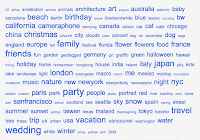
Tag cloud from flickr.com

Here's another useful presentation re tagging from Berlin, called "Tagging that works", also available on www.slideshare.net.

Tagging, as you know, is about letting users attach their own keywords to web pages or objects on a web site (pictures, videos, bookmarks...) that are then made available to other users, normally to improve search.

Folksonomy is a word often used to describe this. When "folks" tag your content they are likely to use colloquial terms closer to what other users would look for. If you have an excellent web site about "canine nutrition" chances are slim that users will find it, as most of them will they search for "dog food". That is, unless you let your users tag it with "dog food" so others can find it as well.

We have the same issue on the ABB web site. Our excellent flow meters are called "flow measurement products", a term that I suspect no sane person would use trying to find them. Likewise, the relevant business unit insists on using terms like turbocharging as opposed to turbochargers, and robotics rather than robots...

However, letting users tag content is not straightforward in our case, not least because we have 28 languages on the web site and suspect that tags must be connected to the correct language version to be effective. It would be interesting to hear from you if anyone has found a good solution to this?